Author Question: Vapor pressure A) is expressed in grams per kilogram. B) frequently exceeds 100mb. C) does not ... (Read 71 times)

Pea0909berry

  • Hero Member
  • *****
  • Posts: 573
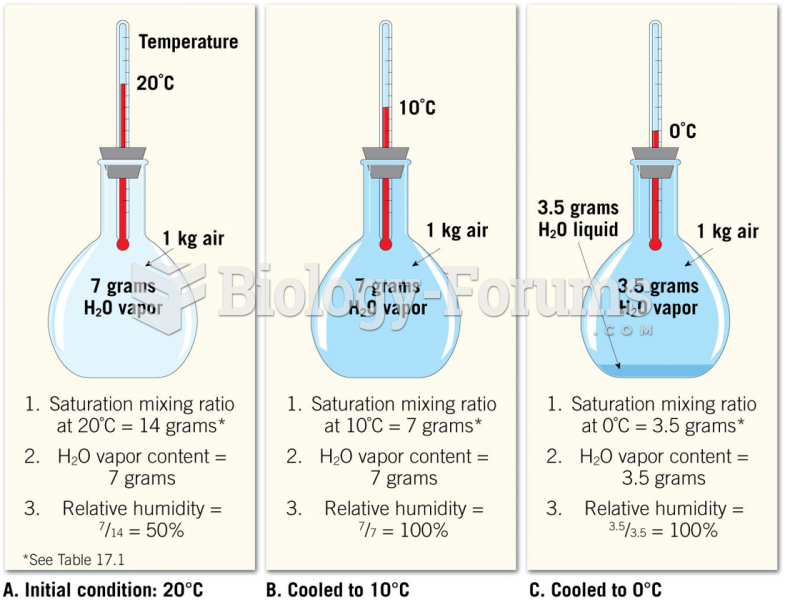
Vapor pressure
 A) is expressed in grams per kilogram.
  B) frequently exceeds 100mb.
  C) does not change if more vapor is added to the air parcel in question.
  D) is dependent upon temperature.
  E) none of the above

Question 2

The mixing ratio
 A) is a relative measure of water vapor.
  B) changes with temperature.
  C) changes with the expansion of a given volume of air.
  D) is expressed in grams of water vapor per kilogram of dry air.
  E) none of the above


tashiedavis420

  • Sr. Member
  • ****
  • Posts: 329
Answer to Question 1

D

Answer to Question 2

D


Related Topics

Need homework help now?

Ask unlimited questions for free

Ask a Question
 

Did you know?

Disorders that may affect pharmacodynamics include genetic mutations, malnutrition, thyrotoxicosis, myasthenia gravis, Parkinson's disease, and certain forms of insulin-resistant diabetes mellitus.

Did you know?

The National Institutes of Health have supported research into acupuncture. This has shown that acupuncture significantly reduced pain associated with osteoarthritis of the knee, when used as a complement to conventional therapies.

Did you know?

Amphetamine poisoning can cause intravascular coagulation, circulatory collapse, rhabdomyolysis, ischemic colitis, acute psychosis, hyperthermia, respiratory distress syndrome, and pericarditis.

Did you know?

There are immediate benefits of chiropractic adjustments that are visible via magnetic resonance imaging (MRI). It shows that spinal manipulation therapy is effective in decreasing pain and increasing the gaps between the vertebrae, reducing pressure that leads to pain.

Did you know?

Signs and symptoms that may signify an eye tumor include general blurred vision, bulging eye(s), double vision, a sensation of a foreign body in the eye(s), iris defects, limited ability to move the eyelid(s), limited ability to move the eye(s), pain or discomfort in or around the eyes or eyelids, red or pink eyes, white or cloud spots on the eye(s), colored spots on the eyelid(s), swelling around the eyes, swollen eyelid(s), and general vision loss.

For a complete list of videos, visit our video library