How do forms compare to lists?
A) Both forms and lists can expand as necessary.
B) Forms, unlike lists, are static so findings have a fixed position.
C) Lists, unlike forms, are static so findings have a fixed position.
D) Forms, unlike lists, can expand as necessary.
Question 2
A(n) ________ analyzes the workflow of the electronic medical record and works to make it as efficient as possible
A) clinical vocabulary manager
B) information services director
C) clinical analyst
D) clinical project manager
E) clinical applications coordinator


 Plant cells expand by taking up water into their vacuoles.
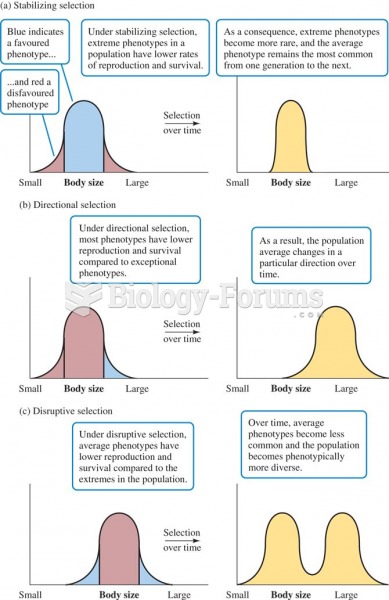 Three principle forms of natural selection: (a) stabilizing selection, (b) directional selection, an
 Different forms of Daphnia pulex can be either sexually reproducing or obligately parthenogenetic.
 GI endoscopy. (a) Similar to other forms of GI endoscopy, laparoscopy involves the insertion of a sp
 Distribution and Forms of Precipitation: Graupel and Hail
 How to expand a polynomial (Part 2)