This topic contains a solution. Click here to go to the answer

Author Question: The nurse is performing a focused musculoskeletal system assessment with a client. How should the ... (Read 190 times)

TFauchery

  • Hero Member
  • *****
  • Posts: 500
The nurse is performing a focused musculoskeletal system assessment with a client. How should the nurse assess for adduction of the hip?
 
  1. Having the client move her hip toward the center of the body
  2. Asking the client to straighten her leg
  3. Having the client move her hip away from midline
  4. Have the client bring her hip up toward the body

Question 2

The nurse is grading muscle strength during an assessment. The nurse should document strength of the arms as a 3 if:
 
  1. the client could perform full range of motion (ROM) against full resistance.
  2. the client could maintain ROM against gravity.
  3. the nurse could feel contraction when there was no movement.
  4. the client could perform full ROM against moderate resistance.


Related Topics

Need homework help now?

Ask unlimited questions for free

Ask a Question
Marked as best answer by a Subject Expert

mceravolo

  • Sr. Member
  • ****
  • Posts: 349
Answer to Question 1

Answer: 1

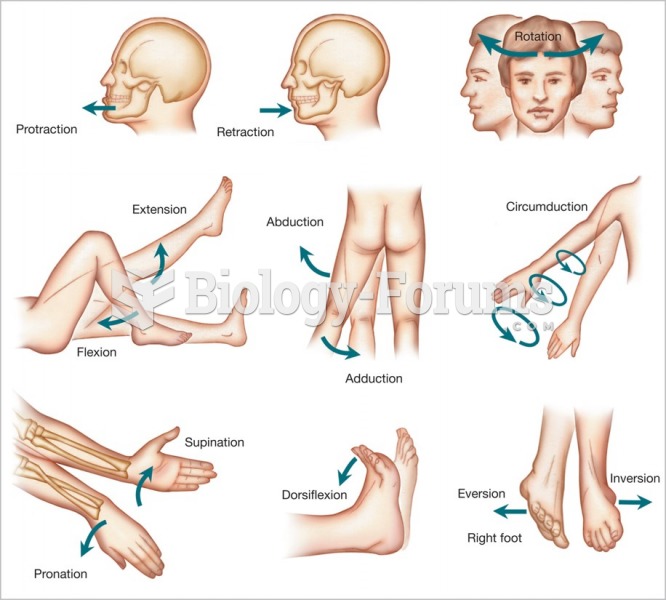
1. Adduction is moving the joint toward the midline of the body.
2. Straightening the leg is extension.
3. Moving the hip away from the body is abduction.
4. Brining the hip up towards the body is flexion.

Answer to Question 2

Answer: 2

1. A score of 5 is given for full ROM against full resistance.
2. A score of 3 is given if the client maintains ROM against gravity.
3. A score of 2 is given if the nurse feels muscle contraction but there is no movement.
4. A score of 4 is given for maintaining ROM against moderate resistance.


Did you know?

Cutaneous mucormycosis is a rare fungal infection that has been fatal in at least 29% of cases, and in as many as 83% of cases, depending on the patient's health prior to infection. It has occurred often after natural disasters such as tornados, and early treatment is essential.

Did you know?

Aspirin may benefit 11 different cancers, including those of the colon, pancreas, lungs, prostate, breasts, and leukemia.

Did you know?

Human kidneys will clean about 1 million gallons of blood in an average lifetime.

Did you know?

The human body's pharmacokinetics are quite varied. Our hair holds onto drugs longer than our urine, blood, or saliva. For example, alcohol can be detected in the hair for up to 90 days after it was consumed. The same is true for marijuana, cocaine, ecstasy, heroin, methamphetamine, and nicotine.

Did you know?

All patients with hyperparathyroidism will develop osteoporosis. The parathyroid glands maintain blood calcium within the normal range. All patients with this disease will continue to lose calcium from their bones every day, and there is no way to prevent the development of osteoporosis as a result.

For a complete list of videos, visit our video library