This topic contains a solution. Click here to go to the answer

Author Question: Which of the following statements regarding drug abuse in the elderly is NOT true? A) The elderly ... (Read 175 times)

waynest

  • Hero Member
  • *****
  • Posts: 553
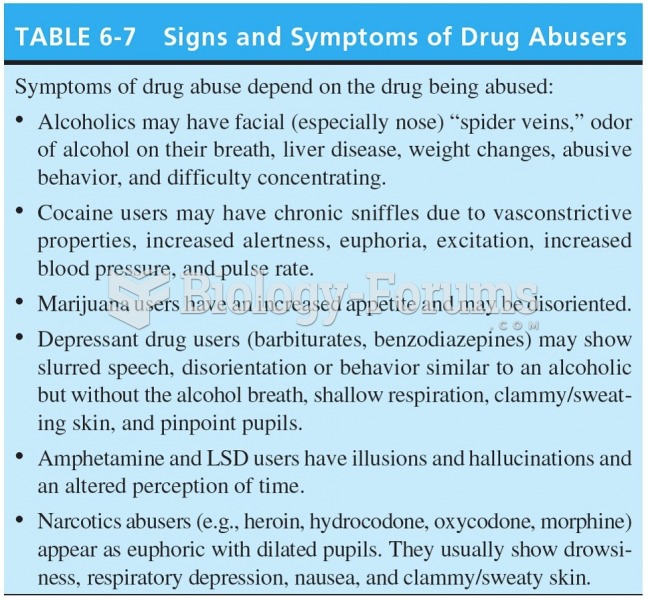
Which of the following statements regarding drug abuse in the elderly is NOT true?
 
  A) The elderly are unlikely to abuse prescription drugs.
  B) Changes in hearing and vision may be due to drug abuse.
  C) Drug abuse in the elderly may include over-the-counter drugs.
  D) Drug abuse is a possibility to consider when dealing with elderly patients with changes in their mental status.

Question 2

An EMT is correctly assessing a patient's radial pulse when he:
 
  A) uses the palm of his hand to feel the pulse on the upper arm.
  B) simultaneously checks for a heart rate on both sides of the neck.
  C) uses his thumb to feel for the pulse on the patient's lower arm.
  D) uses his fingertips to feel for a pulse at the patient's wrist.


Related Topics

Need homework help now?

Ask unlimited questions for free

Ask a Question
Marked as best answer by a Subject Expert

TheNamesImani

  • Sr. Member
  • ****
  • Posts: 334
Answer to Question 1

A

Answer to Question 2

D


waynest

  • Member
  • Posts: 553
Reply 2 on: Jul 2, 2018
Thanks for the timely response, appreciate it


apple

  • Member
  • Posts: 352
Reply 3 on: Yesterday
Excellent


Did you know?

Autoimmune diseases occur when the immune system destroys its own healthy tissues. When this occurs, white blood cells cannot distinguish between pathogens and normal cells.

Did you know?

During pregnancy, a woman is more likely to experience bleeding gums and nosebleeds caused by hormonal changes that increase blood flow to the mouth and nose.

Did you know?

Symptoms of kidney problems include a loss of appetite, back pain (which may be sudden and intense), chills, abdominal pain, fluid retention, nausea, the urge to urinate, vomiting, and fever.

Did you know?

When taking monoamine oxidase inhibitors, people should avoid a variety of foods, which include alcoholic beverages, bean curd, broad (fava) bean pods, cheese, fish, ginseng, protein extracts, meat, sauerkraut, shrimp paste, soups, and yeast.

Did you know?

The first war in which wide-scale use of anesthetics occurred was the Civil War, and 80% of all wounds were in the extremities.

For a complete list of videos, visit our video library