Author Question: Mass and weight on Earth's surface a. are the same thing. b. are defined solely by inertia. c. ... (Read 79 times)

a0266361136

  • Hero Member
  • *****
  • Posts: 538
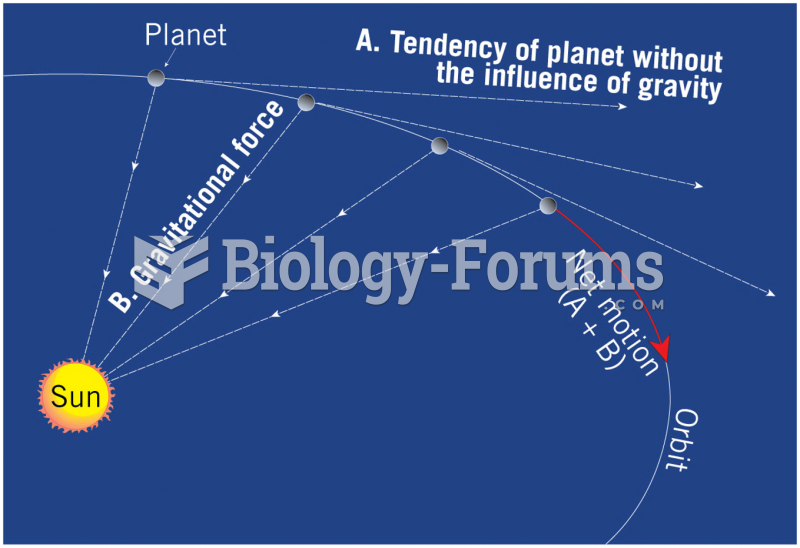
Mass and weight on Earth's surface
 a. are the same thing.
  b. are defined solely by inertia.
  c. are explained by Newton's third law.
  d. differ in magnitude by a constant.
  e. are explained by Kepler's second law.

Question 2

A substance that speeds up a chemical reaction but is not consumed is a(n) ______________.
 Fill in the blank(s) with correct word


courtney_bruh

  • Sr. Member
  • ****
  • Posts: 308
Answer to Question 1

d

Answer to Question 2

catalyst


Related Topics

Need homework help now?

Ask unlimited questions for free

Ask a Question
 

Did you know?

People who have myopia, or nearsightedness, are not able to see objects at a distance but only up close. It occurs when the cornea is either curved too steeply, the eye is too long, or both. This condition is progressive and worsens with time. More than 100 million people in the United States are nearsighted, but only 20% of those are born with the condition. Diet, eye exercise, drug therapy, and corrective lenses can all help manage nearsightedness.

Did you know?

More than nineteen million Americans carry the factor V gene that causes blood clots, pulmonary embolism, and heart disease.

Did you know?

About 80% of major fungal systemic infections are due to Candida albicans. Another form, Candida peritonitis, occurs most often in postoperative patients. A rare disease, Candida meningitis, may follow leukemia, kidney transplant, other immunosuppressed factors, or when suffering from Candida septicemia.

Did you know?

When Gabriel Fahrenheit invented the first mercury thermometer, he called "zero degrees" the lowest temperature he was able to attain with a mixture of ice and salt. For the upper point of his scale, he used 96°, which he measured as normal human body temperature (we know it to be 98.6° today because of more accurate thermometers).

Did you know?

As many as 28% of hospitalized patients requiring mechanical ventilators to help them breathe (for more than 48 hours) will develop ventilator-associated pneumonia. Current therapy involves intravenous antibiotics, but new antibiotics that can be inhaled (and more directly treat the infection) are being developed.

For a complete list of videos, visit our video library