This topic contains a solution. Click here to go to the answer

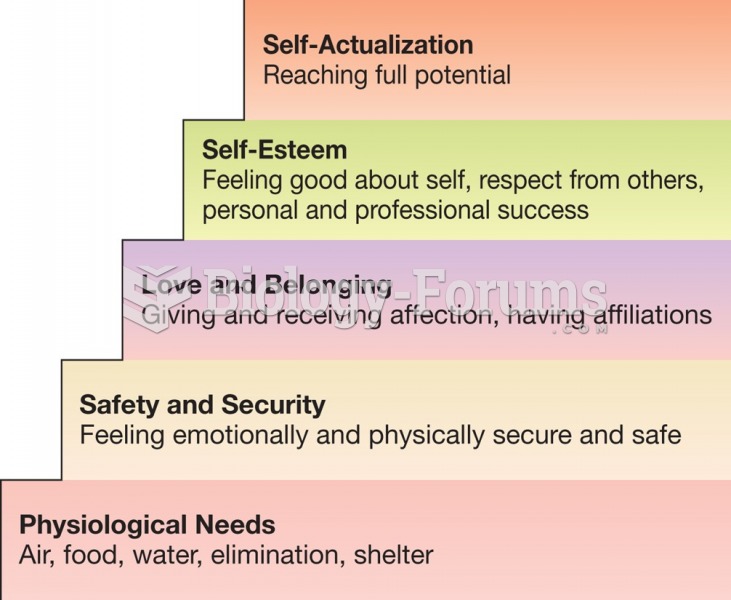
Author Question: Why is Maslow's hierarchy of needs so important to licensed practical nurses (LPNs)? 1. It ... (Read 63 times)

frankwu

  • Hero Member
  • *****
  • Posts: 549
Why is Maslow's hierarchy of needs so important to licensed practical nurses (LPNs)?
 
  1.
  It enables them to label the behavior of a patient.
  2.
  It enables them to judge the patient's behavior.
  3.
  It enables them to understand that each behavior is motivated by a need.
  4.
  It enables them to make assumptions about their patient.

Question 2

Which of the following types of needs are most people more tolerant of?
 
  1.
  Psychological
  2.
  Physiological
  3.
  Safety and security
  4.
  Self-actualization


Related Topics

Need homework help now?

Ask unlimited questions for free

Ask a Question
Marked as best answer by a Subject Expert

LegendaryAnswers

  • Sr. Member
  • ****
  • Posts: 341
Answer to Question 1

ANS: 3
Every behavior has a cause, and every behavior is motivated by a need. Maslow's hierarchy identifies the needs that lead to behaviors and places them on levels.

Answer to Question 2

ANS: 2
Most people are more tolerant of basic, physiological survival needs (food, water, and oxygen) because they are easy to recognize.


frankwu

  • Member
  • Posts: 549
Reply 2 on: Jul 17, 2018
Thanks for the timely response, appreciate it


JCABRERA33

  • Member
  • Posts: 344
Reply 3 on: Yesterday
Wow, this really help


Did you know?

In 1864, the first barbiturate (barbituric acid) was synthesized.

Did you know?

Glaucoma is a leading cause of blindness. As of yet, there is no cure. Everyone is at risk, and there may be no warning signs. It is six to eight times more common in African Americans than in whites. The best and most effective way to detect glaucoma is to receive a dilated eye examination.

Did you know?

When Gabriel Fahrenheit invented the first mercury thermometer, he called "zero degrees" the lowest temperature he was able to attain with a mixture of ice and salt. For the upper point of his scale, he used 96°, which he measured as normal human body temperature (we know it to be 98.6° today because of more accurate thermometers).

Did you know?

As many as 28% of hospitalized patients requiring mechanical ventilators to help them breathe (for more than 48 hours) will develop ventilator-associated pneumonia. Current therapy involves intravenous antibiotics, but new antibiotics that can be inhaled (and more directly treat the infection) are being developed.

Did you know?

More than nineteen million Americans carry the factor V gene that causes blood clots, pulmonary embolism, and heart disease.

For a complete list of videos, visit our video library